

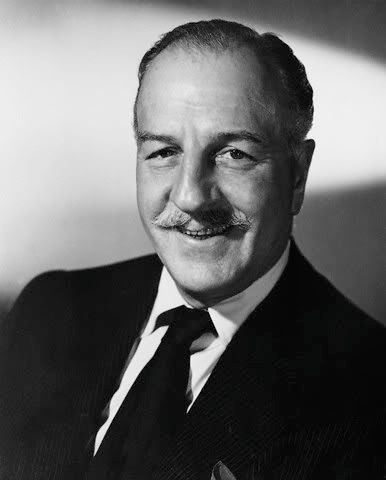
F. Scott Fitzgerald wrote some beautiful prose, but he was far from flawless in his insights. One of his observations that has been happily proven wrong on more than one occasion is that "there are no second acts in American lives." By 1950, tall, distinguished men with velvety voices, hawk-like profiles, a genial world-weariness, and decades of theatrical and cinematic experience were beginning to seem like an endangered species. Louis Calhern (1895-1956) might have stopped being a viable actor around the time that they ceased production of those limos with a crystal bud vase next to the passenger door and stopped making movies in which the virtue of ingénues was threatened by roués like John Barrymore. About 7 years younger than Barrymore, he'd shared a self-destructive streak with The Great Profile, though mercifully Louis never had the publicity of the youngest member of those acting siblings. Calhern did his tippling and romantic pursuits on a quieter scale.
Beginning in films in 1921 in a prophetically named movie called What's Worth While?, directed by the pioneering Lois Weber, Calhern had been an actor since his teens.
 Born Carl Vogt in New York City to middle class parents, he grew up in St. Louis. While playing high school football, (a sport that earned him that distinctive beak), he was spotted by a member of a touring theater company who asked the strapping 6' 4" youngster to join the troupe. After serving in the American Expeditionary Forces in France during the First World War, the young actor decided to ditch the Germanic name in favor of the more aristocratic sounding Louis Calhern. Cutting a wide swath artistically and socially in booming Rochester, N.Y. in theater companies guided by such budding talents as George Cukor and Rouben Mamoulian, Calhern made his first big success among these upstate audiences (especially the girls). He also showed that he had a generous and pragmatic streak in his nature. When an insecure George Cukor struggled to find a place in the regional theater world as a director, Calhern, already regarded as a dazzling success by his slightly younger contemporary, encouraged George to make his way by being himself. Rather than call a planned theater company "The Rochester Theatre Guild" (aping the artistically high-minded NYC Theatre Guild), Louis suggested gently that "Back to Methuselah...may be too heavy for Rochesteries in search of summer entertainment." Calhern went further, encouraging the tyro director to call any company he created "The Cukor Company--or the Cukor Comedy Company...Keep on your toes--you can cut it, young feller." The 25 year old Cukor would never forget the actor's kindness. Making a Broadway splash in 1924 in George M. Cohan's The Song and Dance Man, (the first big show for Mayo Methot as well), he went on to appear in plays with such players as Ann Harding, Dudley Digges, and Wallace Ford. Some of the better plays were written by Ibsen, Philip Barry and Maxwell Anderson during the heady years of the Broadway theater in the '20s.
Lured to Hollywood by the Talkies Revolution, he began the sound era by lusting after Nancy Carroll in an interesting pre-code, Stolen Heaven (1931), directed by theatrical legend, George Abbott. In the James Cagney-Joan Blondell picture Blonde Crazy, made at Warner Brothers, Calhern gave a delightfully sinuous performance as Dapper Dan Barker, one of the few characters who ever got the better of Cagney, at least for a time. Calhern did begin to seem typecast as an smooth miscreant in many of these early films, though his appearance in Diplomaniacs (1933) the Bert Wheeler and Robert Woolsey comedy about international relations as a form of organized insanity. While Wheeler & Woolsy may be an acquired taste, (I think), the straight man style that Calhern brought to the Joseph Mankiewicz movie may have led to his being cast as the Ambassador from Sylvania in an absurdist masterpiece starring The Marx Brothers. Duck Soup (1933), directed by Leo McCarey required very little of Louis' classical training, but his role as the conniving diplomat who thinks he's in league with Harpo and Chico calls on all his powers of conveying exasperation.

Watching Calhern again recently in this film, I began to think that he and Raquel Torres may be the only actors sticking to the script. At times looking a bit puzzled but game throughout the briskly paced satire on war, national pride and most other human endeavors, Calhern must have wondered what he'd gotten himself into in Hollywood.
Despite the steady work provided by the studios, by the end of the '30s Louis Calhern was reduced to appearing in tripe like Charlie McCarthy, Detective (1939) sixth-billed under dummies Mortimer Snerd and the "star" of the show, Charlie.Work was regular, but the need for money by Louis was chronic for alimony and to support his hectic lifestyle. Married four times, all unions ended in divorce. In between trips to the altar, he was, in the words of one of his lady friends, considered "catnip". His first wife, the actress Ilka Chase, married him in 1926 after a whirlwind courtship. Finding him seriously lacking as a life partner (his drinking and dallying didn't help things), Chase divorced him inside of a year. Within a few months, Louis was taking the plunge again, marrying socialite actress Julia Hoyt by the Fall. When Ilka found a box of her old calling cards engraved “Mrs. Louis Calhern” she decided that the expensive cards were too good to throw away. No longer needing them, she immediately sent them to Calhern’s new wife. Knowing her former husband's short marital attention span, Chase wrote to her successor: “Dear Julia, I hope these reach you in time.” After divorcing Miss Hoyt in 1932, Mr. Calhern's serial monogamy began another chapter when he married actress Natalie Schafer in 1932.
 Ms. Schafer, (seen at left with her husband sometime in the 1930s) is perhaps best remembered as ditsy society lady "Mrs. Howell" on tv's Gilligan's Island, though she appeared in dozens of movies as well, including one with her by then former husband, when she and Calhern were both cast in a comedy. Since the pair were divorced in 1942, it was ironic that the film they appeared in was entitled Forever Darling (1956). Mr. Calhern's final dip into the marital pool took place in 1942 with Marianne Stewart, an actress who was the daughter of noted German actor Reinhold Schünzel. Stewart and Louis divorced in 1955.
Pursuing some reported dalliances with such diverse ladies as Dorothy Gish (the fun Gish sister, according to many) and, perhaps most improbably, Marilyn Monroe, Mr. Calhern lived, off and on, at the fabled Garden of Allah in Hollywood, not a spot recommended for anyone seeking to practice the virtues of temperance or fidelity. Yet, unlike some of the denizens of those apartments, Hayward surprised everyone, including himself. After nearly ruining his reputation for good in Hollywood and in the theater, he sobered up, went back to Broadway, and had a third act of his career in films that deserves a closer look.
In 1949, director Lewis Milestone made a film from John Steinbeck's The Red Pony, casting Myrna Loy as a quiet ranch wife and mother and Louis Calhern as her garrulous father, a former wagon train guide who spends his days reliving the past and finding fault with the present.
 He finds himself a stranger in his own house, restless and dissatisfied, troubled to find himself no longer young and resentful of those who are. Repeating the same stories endlessly about the old days, Calhern is both touching and annoying, using his voice to beguile and needle according to his character's sometimes childish whims. His frontiersman is ultimately a touching figure, and, in a moment of self-awareness in the film, comments that he and his kind "are old men, standing on the shore of an ocean, and there is no more west for us."
There were, however, new frontiers for Calhern to explore on film, especially in 1950. One of them may have seemed to be his role recreating his post-war stage hit about Supreme Court Justice Oliver Wendell Holmes on screen. The only film in which Louis is clearly the star, The Magnificent Yankee (1950) shines when it focuses on the domestic side of his life. When Ann Harding as Holmes' wife Fanny lay dying, there is a beautiful scene in which Calhern quietly speaks to her but the public side of Holmes' life is undeveloped.
 I really wanted to like this movie, but found it disappointing overall. Emphasizing the warmth of Holmes' humanity and his friendships with his many law clerks and fellow Supreme Court Justices, (particularly effective in outlining the friendship that formed between the Brahmin and the first Jewish Justice, played by Eduard Franz as Louis Brandeis), it's fun to see Calhern do his lovable codger bit, but where are the history making cases that involved "clear and present danger" to public safety, his controversial decision supporting forced sterilization for "feeble-minded" women under the state's care, or his conflicts with the executive branch? Though it may have been in part a matter of affection for Louis Calhern (and studio block voting at MGM), the actor received his only Oscar nomination for this star turn. Frankly, I don't think that Calhern stood much of a chance of winning. He was competing against Spencer Tracy's greatest comic role in Father of the Bride, James Stewart's excellent playing in Harvey and William Holden's brilliant cynicism in Sunset Boulevard. The Academy, swooning over the cultural élan of Jose Ferrer in Cyrano de Bergerac, threw in the towel when faced with such an embarrassment of riches by such a range of fine actors, and awarded Ferrer the Oscar.
In a career that had its fair share of dark villains, one of Calhern's best may be in director Anthony Mann's little known Devil's Doorway (1950). The film, relatively early in Mann's career, tackles some very big issues that we still struggle with today from the environment to racial and sexual equality to the treatment of veterans.

While I think that the film may have been toned down due to the chilly political atmosphere of the period, that gives a movie trying to deal with many deeply human problems more focus on the flawed characters rather than allowing abstract ideas to overwhelm the story. Calhern is all too human, playing a Mephistopheles-like lawyer whose contempt for the Shoshone Indian well played by Robert Taylor (wearing some truly unfortunate make-up) is introduced as a looming, iconic presence shot from below by the excellent John Alton, a cinematographer best known for his film noir work. The fascinating quality about Louis Calhern's character that caught me was his seeming lack of rational motivation for the destruction he relishes setting in motion in the rural community where he sets neighbor against neighbor. Calhern also imbues his character with a slimy charm that makes him truly intriguing, despite some of the timidity of the script.
In an ironic twist, Louis Calhern, who had done some light singing and dancing in earlier films, (remember Duck Soup?), would next be handed a plum role as Buffalo Bill in Irving Berlin's delightful musical Annie Get Your Gun (1950), although under tragic circumstances. Judy Garland, whose considerable acting and singing talent might have endowed her Annie Oakley with a lovable vulnerability, was overwhelmed by personal troubles, which led to her being fired from the expensive MGM production. She was replaced by the energetic Betty Hutton.
 Male lead Howard Keel, cast as the boastful Frank Butler, broke his ankle during production, further delaying filming. In a further irony, the role that Calhern was asked to play had originally been intended for the great comic supporting player, Frank Morgan, who died suddenly after filming had begun. Under the circumstances, it's a wonder that the film is as entertaining as it is, even though it has what may be Berlin's best score. I was particularly taken with J. Carroll Naish's Sitting Bull and Keenan Wynn's hustler promoter. Yet, it is not the sometimes listless musical numbers or the Wild West show that remains in my memory after seeing this movie, but instead Louis Calhern's old frontiersman turned showman. Calhern's reflective moods at the end of the film that give the film some depth since they are particularly well done, even as his character realizes that he represents an illusion of an Old West that never was.
 The film from Calhern's personal annus mirabilis that I believe should have won him more acknowledgment was his portrait of Alonzo D. Emmerich in The Asphalt Jungle, directed by John Huston. Calhern plays Emmerich as a pillar of the legal community, a sharp cookie who's made a career out of defending the guilty, an impatient yet guilty husband to neurotic May Emmerich (Dorothy Tree), a sugar daddy to Angela Phinlay (Marilyn Monroe, who is excellent), and, in an unfamiliar role for the shyster, a financier for the criminals, led by Sam Jaffe, who has planned this one "perfect heist" while serving a very long stretch in prison. Providing $50k to finance the job, Emmerich, who is nearly bankrupt, tries to manipulate events and people continuously, until faced with unplanned events that threaten to reveal the hollow nature of his life. Calhern plays him as a bit of an exhausted dandy, not averse to the sight of his mistress, but a bit tired of her calling him "Uncle Lon," and, despite his faults, still too fastidious a man to leave a mess behind.
Like all the characters in The Asphalt Jungle (1950), which is only superficially a caper film, Calhern yearns for the big score that will...what? Restore his youth, self-respect, provide him with a way out of his high maintenance marriage and mistress, or allow him to escape from the deep, velvet-lined rut he's dug for himself? Money may be the obvious motive for what Calhern as Emmerich does. It's something more elusive that he's seeking: release from the effort it has taken to keep juggling all the elements of his life.
As his career continued, Calhern would go on to perform a less lethal but no less manipulative version of his Asphalt Jungle character in Executive Suite(1954), a good film that never seemed to come entirely to life, despite a great cast and Robert Wise's direction. In Joseph Mankiewicz' version of Julius Caesar (1953) he would enact the title role as a slightly dyspeptic, jittery Caesar whose theatrical training and Roman profile both helped him with the part. He formed an unlikely friendship on the set as well. If anecdotal reports are to be believed, Marlon Brando, the exemplar of the then new Method Acting, and
 Calhern found each other quite amusing. When, as required for a crucial scene in the film, a strapping young Brando had to carry 250 pound Louis (as a recently assassinated Caesar) across the soundstage just before asking those mercurial Romans to lend him their ears, the director made him do it repeatedly, the actor finally got mad. Spitting out the famous lines of March Antony's eulogy with agitated disgust, he was never better, though it is said that Calhern spoiled several takes when Caesar's cadaver got the giggles.
Calhern's rigorously cynical high school teacher in Blackboard Jungle (1955) and his warmly philosophical Uncle Willie in the fitfully sublime musical adaptation of The Philadelphia Story, High Society (1956) rounded out his career, (though in the guilty pleasure category, he's the only reason I'd watch the laughable, pseudo-biblical all poppycock extravaganza The Prodigal). Sadly, Louis Calhern died just as he was getting ready to appear in another film with his young friend, Marlon Brando. While preparing for Teahouse of the August Moon in Tokyo, Calhern died of a heart attack in May, 1956. He was replaced by comic actor Paul Ford. As Louis Calhern understood well from his own experience as an old pro, the show must go on.
Sources:
Dauth, Brian, editor, Joseph L. Mankiewicz Interviews, University Press of Mississippi, 2008.
Houseman, John, Front & Center 1942/1955, Simon & Schuster, 1979.
McGilligan, Patrick, George Cukor: A Double Life, Harper Perennial, 1992.
Studlar, Gayln, editor, Reflections in a Male Eye: John Huston and the American Experience, Smithsonian Press, 1993.





0 Yorumlar